












How Cannabis Is Tested in the US: State Lab Limits Compared
Every legal batch passes through a state-licensed lab before sale. Here is what those labs measure, the limits seven states set, and where the system still leaks.
This guide is about the United States — not the country you picked in the header.
Key takeaways
- There is no federal cannabis testing standard; each state sets its own analytes and action limits.
- For inhaled products, California, Colorado, New York, Oregon and Massachusetts all cap lead at 0.5 µg/g; Washington allows 1.2 µg/g for all products.
- Water activity of 0.65 or lower is the common flower limit in Colorado, Washington, New York and Oregon.
- California tests every batch for 66 listed pesticides and allows a ±10% gap between label and lab THC.
- Most failures of the system come from sampling, lab choice and potency inflation, not from missing tests.
Cannabis is still federally illegal, so the FDA and USDA do not set its safety limits. Each state writes its own. The result is a patchwork: the same pre-roll can pass in one state and fail across the border.
This explainer covers what a compliance lab actually does to a sample, compares the published limits in seven states, and shows where the checks break down. If you want to read the report itself, start with our line-by-line COA guide.
What happens to a batch before it reaches the shelf
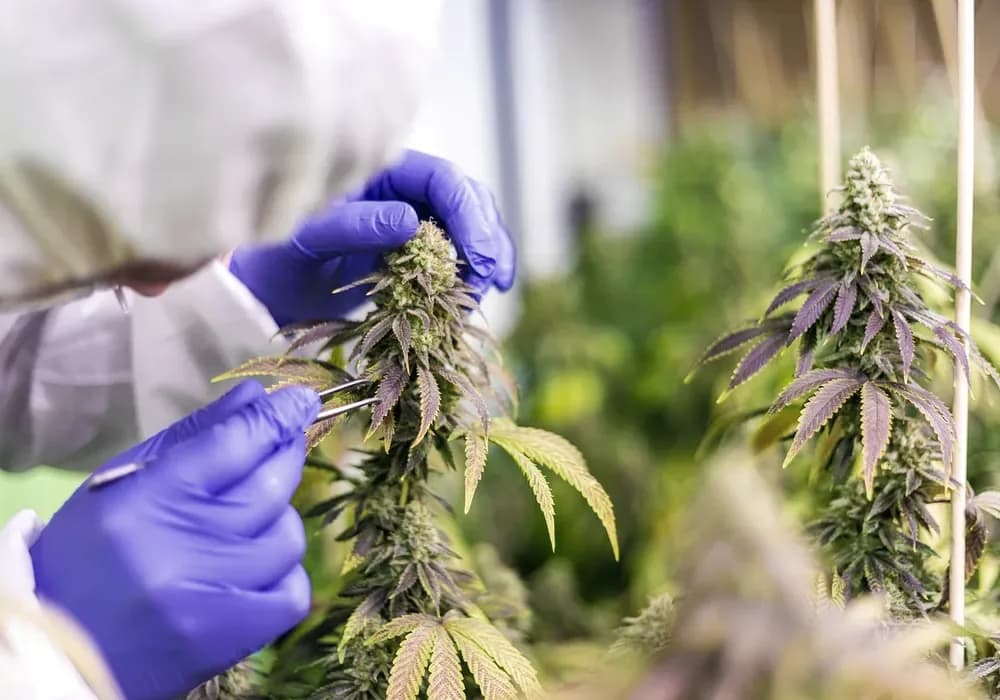
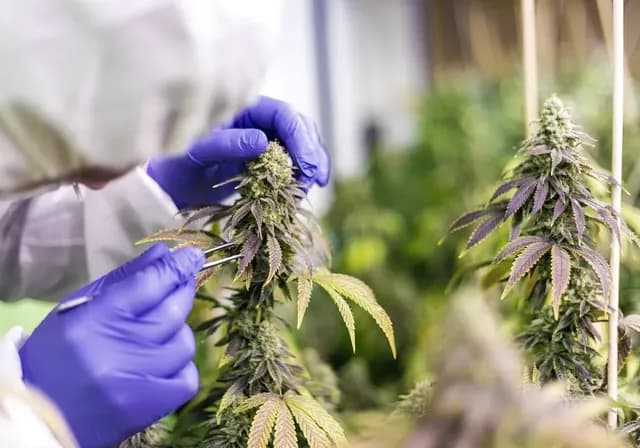
A sample is pulled from a finished batch, sent to a licensed lab, and the batch cannot be sold until the lab reports a pass.
- Sampling
A lab employee or, in New York, a separately licensed sampling firm collects a representative sample from the batch and records it in the state's seed-to-sale system. - Potency
The lab measures cannabinoids, usually by HPLC. California has required one standardized cannabinoid method for flower and pre-rolls since January 1, 2024. - Safety panel
Pesticides, heavy metals, microbes, mycotoxins, residual solvents (for extracts), water activity and moisture, plus foreign material. - Certificate of analysis
Results are reported per analyte with a pass or fail. A failed batch cannot be released for retail sale; states differ on whether it can be remediated and retested.
Potency: what the THC number is allowed to miss by
Potency is a label-accuracy check, not a safety test, and each state sets a tolerance.
California's rule (4 CCR 15307.1) treats a THC or CBD claim as accurate if the certificate of analysis is within plus or minus 10.0% of the label. New York's testing-limits document sets a labeled-potency variance of 90–110% for medical cannabis and 85–115% for adult-use products. Colorado uses a 15% band for retail edibles to qualify for reduced testing.
Labs report total THC as THCA converted with a factor plus delta-9 THC. Our guide on whether THC percentage matters explains why the number is a weak guide to effect.
Action limits in seven states
For inhaled products, most states copy the pharmacopeia-style limits of 0.2 µg/g arsenic and cadmium, 0.5 µg/g lead and 0.1 µg/g mercury; Washington and Michigan's flower limits are looser.
| State | Lead / Arsenic / Cadmium / Mercury (µg/g, inhaled) | Microbial pass criteria | Moisture / water activity (flower) | Pesticides |
|---|---|---|---|---|
| California | 0.5 / 0.2 / 0.2 / 0.1 | No detection of 4 Aspergillus species, Salmonella or STEC | Water activity tested | 66 listed analytes; new action levels take effect Oct. 1, 2026 |
| Colorado | 0.5 / 0.2 / 0.2 / 0.1 | STEC, Salmonella, Aspergillus absent in 1 g; yeast and mold under 10,000 CFU/g | ≤ 0.65 aw | State list |
| Washington | 1.2 / 2.0 / 0.82 / 0.40 (all products) | STEC and Salmonella under 1 CFU/g; bile-tolerant gram-negative bacteria ≤ 10,000 CFU/g | ≤ 0.65 aw | WAC 314-55-108 list; unlisted pesticides 0.1 ppm |
| Michigan* | Flower 1.0 / 0.4 (inorganic) / 0.4 / 0.2; concentrates 0.5 / 0.2 / 0.2 / 0.1 | Per CRA technical guidance | Per CRA technical guidance | State list |
| New York | 0.5 / 0.2 / 0.2 / 0.1, plus antimony, chromium, copper, nickel | Salmonella absent; 4 Aspergillus species tested on flower and inhaled products | ≤ 0.65 aw; moisture ≤ 15.0% | OCM list |
| Massachusetts | 0.5 / 0.2 / 0.2 / 0.1 ("all uses") | Per CCC protocol | Per CCC protocol | CCC protocol list |
| Oregon | 0.5 / 0.2 / 0.2 / 0.1 | STEC and Salmonella (items made after March 1, 2023) | ≤ 0.65 aw; moisture ≤ 15% | OHA Exhibit A, Table 3 |
Sources: state rules and regulator documents listed below, checked September 2026. *Michigan figures come from a search summary of the CRA technical guidance, which blocked direct download; treat them as provisional. "State list" means the state publishes a pesticide list we did not count.
What the numbers mean in practice
- Lead: a Washington flower testing 1.0 µg/g passes; the same flower fails in California, Colorado, New York and Oregon.
- Arsenic: Washington's 2.0 µg/g is ten times the 0.2 µg/g limit for inhaled products in Colorado and New York.
- Water activity: 0.65 aw is the shared line because mold growth becomes likely above it.
- Extra metals: New York also caps nickel at 5.00 µg/g for adult-use flower and pre-rolls, and chromium and copper.
Microbes, mycotoxins and solvents
Pathogen tests are usually presence/absence: any detection in the tested gram fails the batch.
- Pathogens most states screen
- Salmonella, STEC E. coli, Aspergillus (fumigatus, flavus, niger, terreus)
- Colorado yeast and mold
- < 10,000 CFU/g
- Washington mycotoxins
- Aflatoxins 20 µg/kg; ochratoxin A 20 µg/kg
- Colorado solvents
- Butane, propane, ethanol < 1,000 ppm; toluene < 180 ppm; hexane < 60 ppm
Aspergillus matters most for inhaled products, because spores go straight to the lungs. California lists four species; a detection of any of them fails the sample.
Where testing fails
The published limits are rarely the weak point; the weak points are who picks the lab, who pulls the sample, and whether regulators check the results.
- Lab shopping. Producers pay the lab and can choose it. Massachusetts ordered, from April 1, 2025, that each test sample go to a single lab, saying the change would help it enforce against lab shopping. Our investigation of THC inflation covers the evidence.
- Label drift. A 2025 study in Scientific Reports bought 277 Colorado products: 96% of concentrates but only 56.7% of flower were within ±15% of the label.
- Lab misconduct. California revoked the licenses of four labs between December 2023 and July 2024, each involved in inflating THC potency. Michigan recalled about 64,000 pounds of product tested by Viridis Laboratories in November 2021.
- Reporting gaps. A Massachusetts State Auditor audit covering 2019 and 2020 found that the Cannabis Control Commission did not ensure that businesses and labs properly reported products that tested positive for pesticides.
- Uneven limits. Washington's looser metal limits and optional heavy-metal testing for non-medical products mean "passed" does not mean the same thing everywhere.
Limits of this data
We compared inhaled-product limits because flower and vapes are what most buyers purchase; edible and topical limits are higher in most states. Rules change often: California adopted new pesticide action levels (rulemaking DCC-2025-03-R, approved July 27, 2026) that take effect October 1, 2026, and New York revised its testing limits on February 9, 2026.
We did not count every state's pesticide list, and Michigan's numbers are from a secondary summary. Always check the regulator's current document before relying on a number, and confirm the seller is licensed with our license check guide.
FAQ
Is cannabis tested for heavy metals in every legal state?
Most adult-use states require heavy-metal testing for inhaled products. Washington requires it only for products sold as DOH-compliant medical products, though its limits apply to all products. Check your state's rule for which product types are covered.
What is the lead limit for cannabis?
For inhaled products, California, Colorado, New York, Oregon and Massachusetts use 0.5 µg/g. Washington's limit is 1.2 µg/g for all products. Edible limits are often higher, such as 1 ppm in Colorado.
What does water activity 0.65 mean on a COA?
Water activity measures how much free water is available for microbes. Colorado, Washington, New York and Oregon fail flower above 0.65 aw, a level chosen because mold growth becomes likely above it.
How accurate does the THC label have to be?
California allows a ±10.0% difference between label and certificate of analysis. New York uses 90–110% for medical cannabis and 85–115% for adult-use products. Studies show flower labels often miss even these bands.
Who tests cannabis, the state or private labs?
Private labs licensed by the state do almost all compliance testing and are paid by the businesses whose products they test. Michigan has been building a state reference lab to audit the private ones.
Sources
- California Department of Cannabis Control (via Cornell LII) — 4 CCR § 15723 — Heavy Metals Testing · checked Sep 2026
- California Department of Cannabis Control (via Cornell LII) — 4 CCR § 15307.1 — Quality-Assurance Review for Labeling Cannabinoids · checked Sep 2026
- Colorado Marijuana Enforcement Division (via Cornell LII) — 1 CCR 212-3 Rule 4-215 — Contaminant Testing · checked Sep 2026
- Washington State Legislature — WAC 314-55-102 — Quality assurance and quality control · checked Sep 2026
- New York Office of Cannabis Management — Cannabis Testing Limits (Revision February 9, 2026) · checked Feb 2026
- Massachusetts Cannabis Control Commission — Exhibit 4 — Limits for Metals · checked May 2021
- Oregon Health Authority / Secretary of State — OAR 333-007 Marijuana and Hemp Testing · checked Sep 2026
- Michigan Cannabis Regulatory Agency — Sampling and Testing Technical Guidance for Marijuana Products · checked Sep 2026
- Scientific Reports (Giordano et al., 2025) — Accuracy of labeled THC potency across flower and concentrate cannabis products · 2025
- Massachusetts Cannabis Control Commission — CCC tightens testing requirements (single-lab order) · checked Dec 2024
More on safety
How to Spot a Counterfeit Vape Cart: A 60-Second Checklist
Verdex Editorial Team · Oct 7, 2026 · 7 min read
THC Gummies and Vapes in Australia: What's Actually Legal in 2026
Verdex Editorial Team · Oct 7, 2026 · 3 min read
Prague 'Cannabis Shops': What They Can Legally Sell in 2026
Verdex Editorial Team · Oct 7, 2026 · 3 min read
Cannabis in Mexico for Tourists: Cancún, Mexico City and Fines
Verdex Editorial Team · Oct 7, 2026 · 4 min read
STIIIZY Dispensary Guide: Stores, Pods, Deals and Recalls
Verdex Editorial Team · Oct 7, 2026 · 4 min read
CBD Shops in Belgium: What's Legal to Sell in 2026
Verdex Editorial Team · Oct 7, 2026 · 3 min read
Is Weed Legal in Ireland? What the Law Says in 2026
Verdex Editorial Team · Oct 7, 2026 · 4 min read
How Long Does THC Stay in Your System? Urine, Blood, Saliva, Hair
Verdex Editorial Team · Oct 7, 2026 · 6 min read
Growing Cannabis at Home Legally: Plant Limits by State and Country
Verdex Editorial Team · Oct 7, 2026 · 5 min read
Comments
No comments yetQuestions, corrections or your own experience — start the conversation.