































Edibles Dosing: Why Onset Takes Longer and How Labeling Works
Eaten THC takes a slower road through the body than smoked THC. What science and regulators say about timing, serving sizes, package limits and child safety.
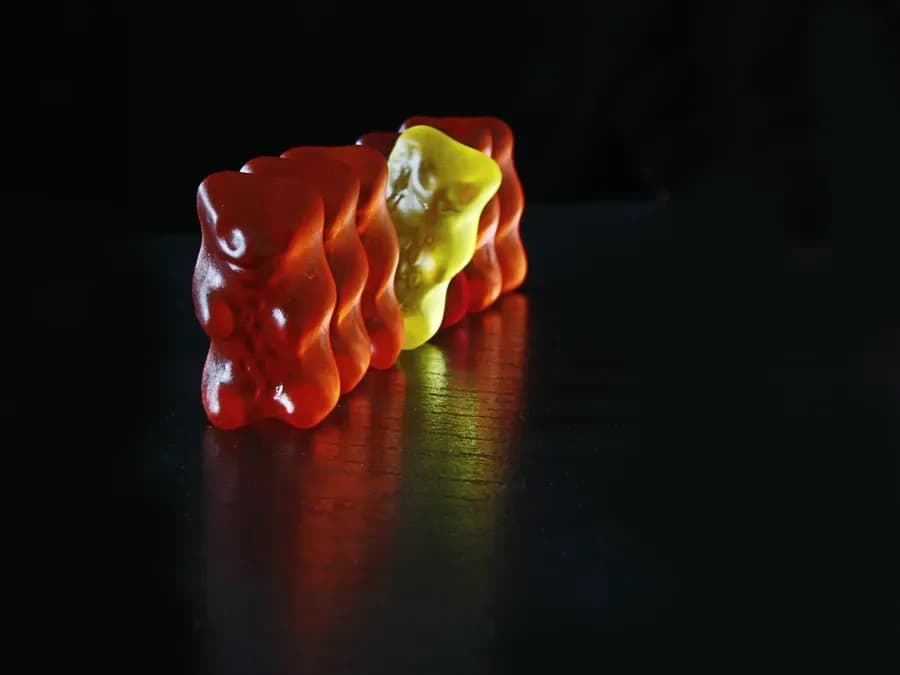
Key takeaways
- Health Canada says effects of eaten cannabis can start within 30 minutes to 2 hours and last up to 24 hours.
- Swallowed THC passes through the liver first, where it is converted to 11-hydroxy-THC, an active metabolite found at much higher levels after eating than after smoking.
- Colorado advises starting with less than one 10 mg serving and waiting at least 90 minutes, and up to four hours, before taking more.
- Legal limits differ: 10 mg of THC per package in Canada; 10 mg per serving and 100 mg per package in California, Colorado and Washington.
- Reported edible exposures in U.S. children under 6 rose from 207 in 2017 to 3,054 in 2021. Store edibles locked away and call Poison Control if a child eats one.
The most common edibles story goes like this: someone eats a gummy, feels nothing after 45 minutes, eats another, and an hour later feels far more than they wanted. The problem is not a bad product. It is timing. THC that you swallow takes a slower, different route through the body than THC you inhale, and the effects arrive later and last longer.
This explainer covers why that happens, what official sources say about onset and duration, how serving and package labels work in major markets, and what to do if a child or pet gets into edibles.
Why do edibles take longer to kick in? First-pass metabolism and 11-OH-THC
Swallowed THC must pass through the gut and liver before it reaches the rest of the body. When you inhale cannabis, THC is absorbed through the lungs. When you eat it, THC has to be absorbed through the gut and then pass through the liver, a step called first-pass metabolism. A review of human cannabinoid pharmacokinetics by Marilyn Huestis, published in 2007, summarizes what this means in numbers:
- Slower peak: across studies, peak THC levels in blood occurred roughly 1 to 5 hours after swallowing, and around 4 to 6 hours in one study using 15 to 20 mg doses.
- Lower and less predictable absorption: estimates of oral bioavailability vary; one careful study put it at about 6%.
- A second active compound: during that first pass through the liver, a significant share of THC is converted to 11-hydroxy-THC (11-OH-THC), which the review describes as equipotent to THC.
11-hydroxy-THC (11-OH-THC)
A metabolite the liver makes from THC. After smoking, blood levels are much lower, around 10% of THC levels; after eating, a much larger share of the active compounds in your blood is this metabolite.
That last point is the one that makes edibles feel different. Because 11-OH-THC is active too, eating cannabis is not simply a slower version of smoking the same amount.
Onset and duration: 30 minutes to 2 hours to start, up to 24 hours to wear off
Exact timing varies with the person, the product and what else is in your stomach. These are the ranges published by health agencies and regulators we checked:
| Source | When effects start | When effects are full | How long they last |
|---|---|---|---|
| Health Canada | 30 minutes to 2 hours | Not specified | Up to 24 hours |
| Colorado (cannabis.colorado.gov) | Not specified | Up to 4 hours | Not specified |
| Huestis review, 2007 (blood levels, not feelings) | Not applicable | Peak blood THC about 1 to 5 hours | Not applicable |
Serving sizes and package limits: 10 mg per serving in the U.S., 10 mg per package in Canada
Regulated edibles are labeled in milligrams of THC, usually both per serving and per package. The limits are set by each jurisdiction:
| Market | Per serving | Per package | Notes |
|---|---|---|---|
| Canada | — | 10 mg THC | The limit applies to the whole package of legal edible cannabis |
| California | 10 mg THC | 100 mg THC | Medical-only orally dissolving products may hold up to 500 mg per package, in servings of no more than 10 mg |
| Colorado | 10 mg THC or less | 100 mg THC | Retail edibles must have clearly marked single servings |
| Washington | 10 mg active Δ9-THC | 100 mg active Δ9-THC | Other THC compounds capped at 0.5 mg each and 1.0 mg combined per serving |
The comparison is striking. An entire legal package of edibles in Canada holds the same 10 mg of THC as a single serving in California, Colorado or Washington, where one package can hold ten servings. If you travel or buy products from different markets, check the milligrams rather than assuming that "one gummy" means the same thing everywhere. Our Canada, California and Colorado guides cover the local rules in more detail.
How to read an edible label, in order
- THC per serving — the dose in one piece or one marked portion.
- Servings per package — a 100 mg chocolate bar split into ten squares is ten 10 mg servings, not one snack.
- Total THC per package — the number that matters if a child or pet gets into it.
- Other cannabinoids — CBD or minor cannabinoids, if listed.
- Batch number — so you can match the product to its lab report. Our methodology explains why we value sellers that publish these.
A cautious approach: less than one 10 mg serving, then wait 90 minutes
Colorado's state cannabis site gives the clearest practical guidance we found. If you aren't sure how cannabis will affect you, it advises taking less than one 10 mg serving and waiting at least 90 minutes, and up to four hours, before eating or drinking more. It also notes that a single 10 mg serving will likely affect your ability to drive, bike or do other activities, especially for occasional consumers.
- Check the label first
Know the milligrams per serving and how the product is divided before you take a bite. - Take less than you think you need
Colorado's advice is less than one 10 mg serving if you are unsure how it will affect you. - Wait, and set a timer
At least 90 minutes before considering more; full effects can take up to four hours. - Plan for the long tail
Don't drive, and don't plan anything that needs a clear head for the rest of the day. Health Canada says effects can last up to 24 hours. - Store the rest safely
Locked, out of sight and reach of children and pets, and separate from regular food.
Children, pets and accidental ingestion: exposures rose from 207 to 3,054 a year
Edibles look like food, and that is the core of the risk for children. A study in the journal Pediatrics analyzed U.S. poison center data for children under 6 who were exposed to edible cannabis.
207 → 3,054
reported edible exposures in children under 6, 2017 vs. 2021
Tweet et al., Pediatrics, 2023
97.7%
of exposures happened in a home
Tweet et al., Pediatrics, 2023
22.7%
of children in reported cases were admitted to hospital
Tweet et al., Pediatrics, 2023
The study counted 7,043 exposures over five years, and 70% of cases followed to a known outcome involved central nervous system depression.
Hemp-derived products are part of the picture too, according to the FDA:
| FDA figure (delta-8 THC products) | Period | Detail |
|---|---|---|
| 2,362 exposure cases reported to U.S. poison centers | January 2021 to February 2022 | 82% of the unintentional exposures involved children |
| 104 adverse event reports received by the FDA | December 2020 to February 2022 | 55% required intervention, such as evaluation by emergency medical services, or hospital admission |
Reported symptoms included hallucinations, vomiting, tremor, anxiety, dizziness, confusion and loss of consciousness.
Signs of cannabis poisoning in children
Health Canada lists these signs, and notes that most cases in kids under 12 occur in children under 5:
- vomiting, confusion, unresponsiveness;
- slurred speech, unsteadiness on the feet;
- drowsiness or lethargy, slowed breathing;
- in rare cases, seizures.
Keep edibles away from pets as well. If an animal eats one, call your veterinarian or an emergency animal clinic right away and have the package at hand.
When to get medical help for yourself or a friend
Get medical help right away if someone who has taken too much has any of these:
- Chest pain — or trouble breathing.
- A seizure — call emergency services.
- Can't stay awake or be woken — do not wait it out.
- Severe confusion — especially if it is getting worse.
In the U.S. and Canada, poison centers can also advise adults on what to do; the numbers above work for any age. Don't let the person drive, and don't leave them alone while effects are strong.
This article is for general information and is not a substitute for professional medical advice.
FAQ
How long does it take for an edible to kick in?
Health Canada says effects of eaten or drunk cannabis can start within 30 minutes to 2 hours. Colorado notes that edibles can take up to four hours to reach full effect, which is why it advises waiting at least 90 minutes before taking more.
How long do edibles last?
Health Canada says the effects of eaten or drunk cannabis can last up to 24 hours. Plan the rest of your day, including any driving, around that.
Why do edibles feel stronger than smoking?
Swallowed THC passes through the liver, which converts part of it into 11-hydroxy-THC, a metabolite a pharmacology review describes as equipotent to THC. Blood levels of 11-OH-THC are much higher after eating than after smoking.
What is a standard edible serving size?
In California, Colorado and Washington, a single serving can contain no more than 10 mg of THC and a package no more than 100 mg. In Canada, an entire package of edible cannabis is limited to 10 mg of THC.
What should I do if my child ate a THC gummy?
Call Poison Control right away: 1-800-222-1222 in the U.S. or 1-844-POISON-X in Canada (1-800-463-5060 in Quebec). Call 911 if the child is unresponsive, has trouble breathing or has a seizure. Keep the package.
Can you take a second edible if the first one doesn't work?
Colorado's guidance is to wait at least 90 minutes, and up to four hours, before eating or drinking more, because edibles can take that long to reach full effect.
Sources
- Health Canada — Health effects of cannabis · Mar 25, 2024
- U.S. Food and Drug Administration — Lung Injuries Associated with Use of Vaping Products (Poison Control contact) · Apr 13, 2020
- Colorado Department of Public Health and Environment (cannabis.colorado.gov) — Safety with edibles · checked Sep 2026
- Huestis MA, via PubMed Central — Human Cannabinoid Pharmacokinetics (Chemistry & Biodiversity, 2007) · checked Aug 2007
- Legal Information Institute, Cornell Law School — Cal. Code Regs. tit. 4, § 17304 — THC Limits · checked Sep 2026
- Washington State Legislature — WAC 314-55-095 — Cannabis servings and transaction limitations · checked Sep 2026
- Health Canada — Accidental ingestion of illegal copycat edible cannabis products causing serious harm · May 10, 2023
- Health Canada — Cannabis poisonings in children · Jul 8, 2024
- American Academy of Pediatrics (Tweet, Nemanich, Wahl) — Pediatric Edible Cannabis Exposures and Acute Toxicity: 2017–2021 (Pediatrics 151(2)) · Feb 1, 2023
- U.S. Food and Drug Administration — 5 Things to Know about Delta-8 Tetrahydrocannabinol – Delta-8 THC · May 4, 2022
More on lab & science
How Long Does THC Stay in Your System? Urine, Blood, Saliva, Hair
Verdex Editorial Team · Oct 7, 2026 · 6 min read
How to Read a Cannabis Lab Report (COA): A Line-by-Line Guide
Verdex Editorial Team · Oct 7, 2026 · 6 min read
STIIIZY Dispensary Guide: Stores, Pods, Deals and Recalls
Verdex Editorial Team · Oct 7, 2026 · 4 min read
How to Spot a Counterfeit Vape Cart: A 60-Second Checklist
Verdex Editorial Team · Oct 7, 2026 · 7 min read
CBD Shops in Belgium: What's Legal to Sell in 2026
Verdex Editorial Team · Oct 7, 2026 · 3 min read
Is Weed Legal in Ireland? What the Law Says in 2026
Verdex Editorial Team · Oct 7, 2026 · 4 min read
Growing Cannabis at Home Legally: Plant Limits by State and Country
Verdex Editorial Team · Oct 7, 2026 · 5 min read
Comments
No comments yetQuestions, corrections or your own experience — start the conversation.